
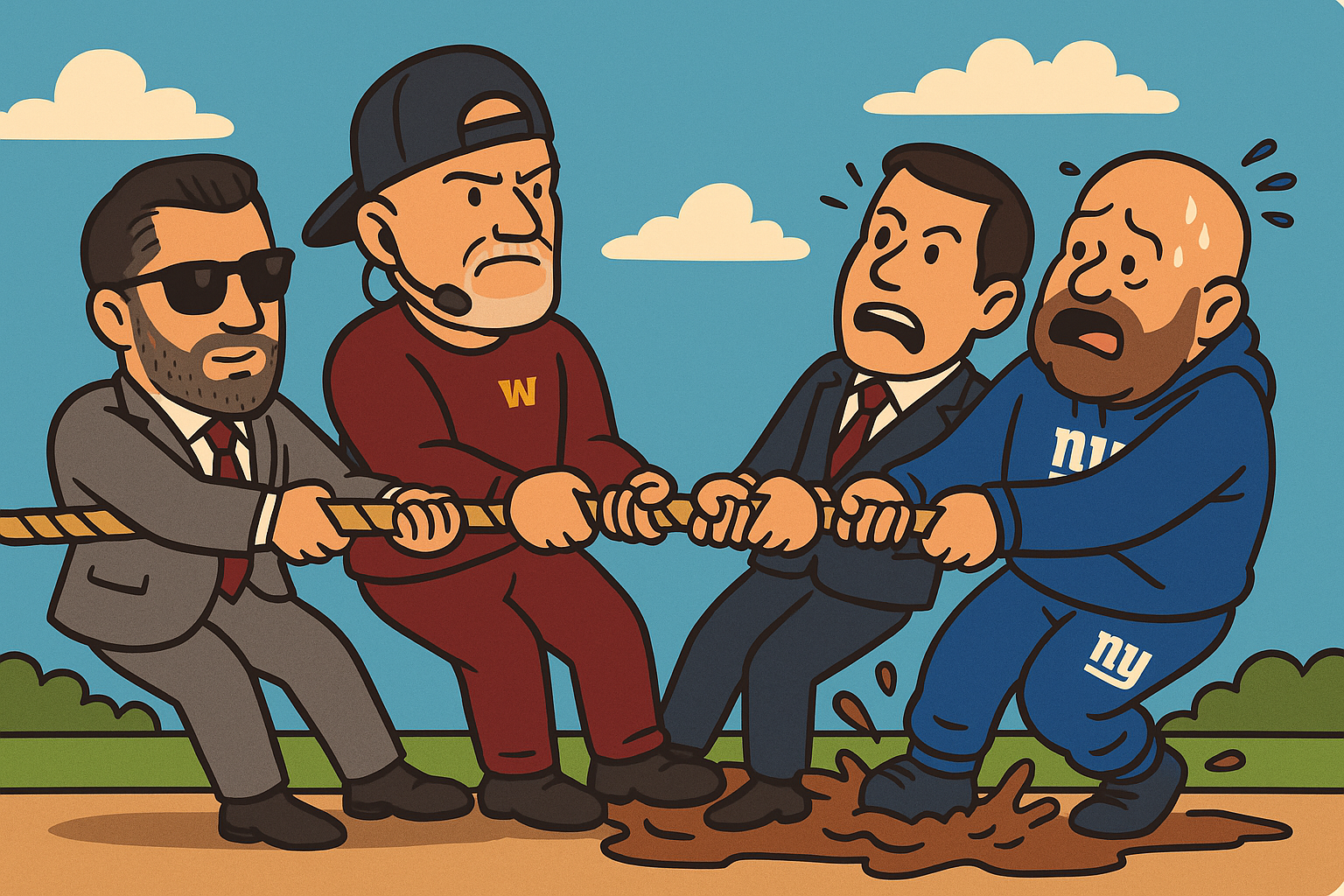
Washington opened the regular season at home against the division-rival Giants and delivered a 21–6 win that set the tone for what this new era is supposed to look like. It wasn’t perfect — Week 1 games rarely are — but it was decisive in all the right ways. Here are four thoughts on the opener:
1. The Rivalry Is Finally Tilting Our Way
For years, the Giants have been the thorn in Washington’s side. It didn’t seem to matter what the records were — playoff push or lost season, Eli Manning era or Daniel Jones era — the one constant was that New York almost always walked away with the win. From 2008 through 2023, the Giants held a dominant 22-11-1 record in the series, a lopsided run that made every matchup feel uphill before kickoff.
That script has flipped. Sunday’s victory makes three straight over the Giants dating back to Dan Quinn’s first season in 2024. Rivalries don’t turn overnight, but they do shift when one team starts stacking wins and expecting to dominate.
What used to be a dreaded matchup now feels like one Washington should own. That’s a meaningful cultural shift for a franchise trying to reset its identity under Adam Peters and Dan Quinn.
2. A Sloppy Game, but That’s Week 1 Football
Let’s be honest: this was not a clean performance. False starts stalled drives, holding calls frustrated both sides of the ball, and an unnecessary roughness penalty even gifted New York an extension.
With starters barely seeing preseason snaps anymore in the name of injury protection, that kind of sloppiness has become the norm in early September.
The difference on Sunday was how Washington handled it. Instead of unraveling, the Commanders absorbed the miscues, regrouped, and kept control. The defense looked sharper than the offense — as it usually does in Week 1 — but the key is this: the sloppiness never dictated the outcome.
3. Learning How to Close Games
One of the most frustrating patterns of the Rivera, Gruden, Shanahan, and Zorn years was Washington’s tendency to let teams linger. How many times did we see a halftime lead evaporate because coaches failed to make adjustments or the team simply fell asleep in the third quarter? More often than not, those games ended in heartbreak.
Quinn’s squad is starting to flip that narrative. Even while playing far from their best, they put the Giants away in the fourth quarter and never let them off the mat. That’s the same killer instinct we saw last season in comfortable wins over Cincinnati and Arizona. Not every game will end like that, but this is how good teams separate themselves — by closing the door instead of leaving it cracked.
4. The Defense Silences the “Pass Rusher Panic” Crowd
All offseason, we heard it: draft a pass rusher, sign a pass rusher, panic about the pass rush. Journalists who moonlight as GMs wrote column after column blasting Adam Peters — “He led the team in sacks!!” … “How could he let Dante Fowler walk?” … “What was he thinking passing on an edge rusher in the draft?” … and my personal favorite, accusing Peters of being asleep at the wheel for not signing a journeyman who’s been on five teams in five years.
To all of you: please stop talking, because you have absolutely no clue what you’re talking about.
Peters had a plan. Yes, Fowler led the team in sacks last year — but he was also a massive liability against the run. Washington’s defensive line was getting shoved around, plain and simple. Peters fixed that by strategically adding the right pieces to get bigger and stouter: Javon Kinlaw, Deatrich Wise, Eddie Goldman. On Sunday, that vision showed up. New York Giants rookie Cameron Skatteboo might turn into a good back someday, but against Washington’s front he got nothing. Meanwhile, the interior line collapsed the pocket again and again, generating rare pressure right through the middle of New York’s offense. Wilson faced pressure on 50% of his passes, was sacked twice, and hit eight times.
And it wasn’t just the line. The secondary deserves credit for making that pressure count. Marshon Lattimore looked every bit the shutdown corner Washington has lacked for years, while Trey Amos held his own outside in his NFL debut. That stability finally let Mike Sainristil stay where he belongs — in the slot, his natural and most effective position. Noah Igbinoghene, listed as the backup slot corner, also brought steady depth when called on, keeping the coverage tight. Together, this group turned what used to be Washington’s defensive soft spot into a strength. It was disciplined, physical, suffocating defense from front to back. In AP we trust.
Week 1 is never about perfection — it’s about setting a tone. Washington opened the season at home, took down a division rival for the third straight time, overcame sloppy play, and leaned on a defensive line and secondary that look rebuilt in all the right ways. That’s a tone worth setting.
The offense will clean up the penalties. The defense already looks meaner and more physical. And the culture shift that started last year under Adam Peters and Dan Quinn feels like it’s gaining momentum.
And to all the wannabe GM columnists: kindly STFU.
Leave a Reply