
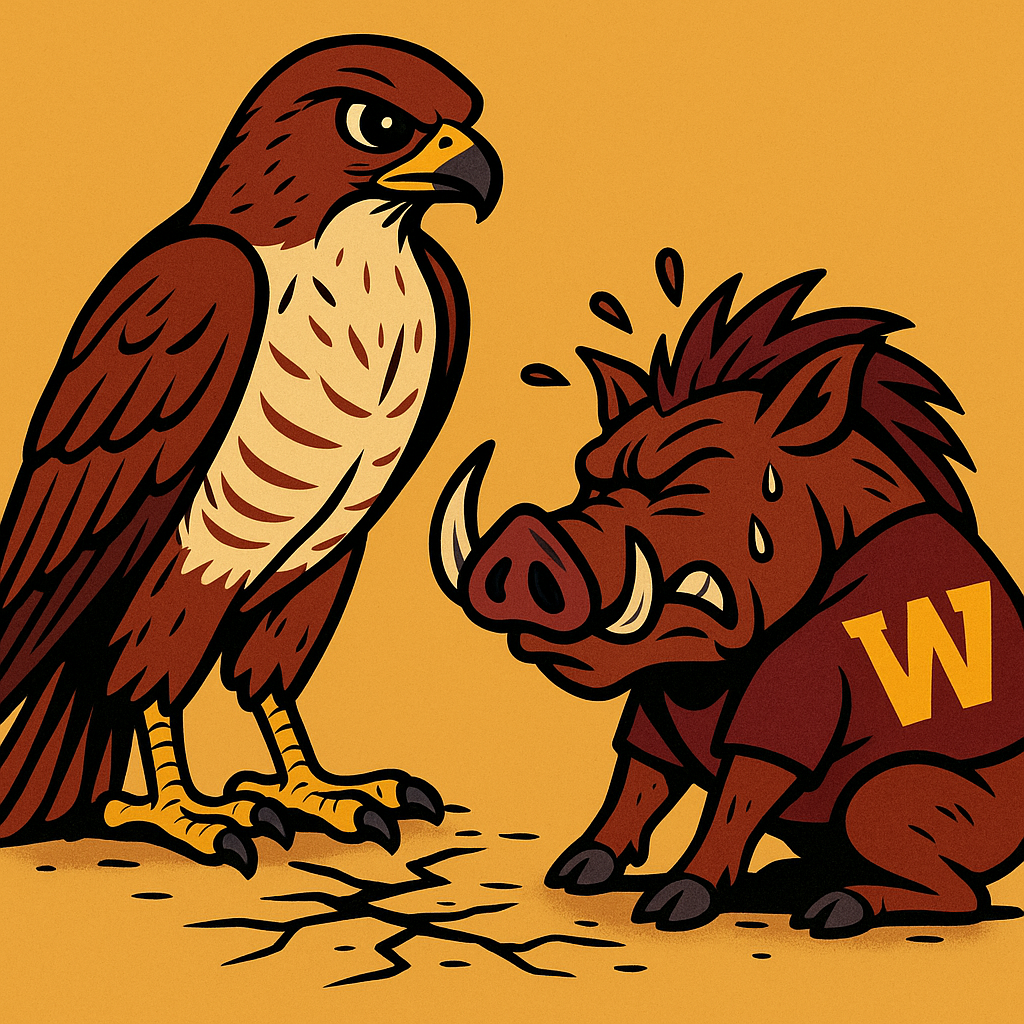
The Commanders’ 2–2 record feels disappointing to some fans, especially after Sunday’s loss in Atlanta. But to stop at “bad loss” is to miss the point. This game wasn’t about one blown coverage, one missed throw, or one ugly stat line. It was about what happens when a team in the midst of a re-build (or recalibration as DQ likes to call it) runs into a talented, motivated opponent — and what that reveals about where Washington is in its rebuild.
1. False Expectations, Real Falcons
Too many people assumed Washington should win this game simply because Atlanta had just been embarrassed by Carolina, 28–0. That’s not how the NFL works.
The Falcons are stacked with talent on both sides of the ball. If anything, they had been underperforming their first few weeks. They were due to bounce back, and losing to Carolina gave them all the motivation they needed. What Washington ran into wasn’t a soft opponent — it was a talented, angry team correcting back to its mean.
Washington, meanwhile, has looked exactly like a .500 team: two strong performances and two duds. This game didn’t change that math.
2. Coordinators Make Mistakes Too
Joe Whitt Jr. has taken plenty of criticism for how the defense played against Atlanta. Some of that’s fair. His scheme and adjustments weren’t sharp, and the Falcons took advantage. Coordinators aren’t perfect — especially one with only one full season as defensive coordinator under his belt.
Remember Cliff Kingsbury last season? In the first Eagles matchup, one key criticism was that he didn’t get Terry McLaurin involved early enough and kept him in static alignments that made him easier to defend. He got hammered for it. But by the second meeting, he began varying alignments, using more motion, and finding ways to scheme McLaurin open.
This was Whitt’s first “under fire” moment of the year. It won’t be his last, but it also doesn’t mean he’s the wrong man for the job.
3. Defensive Struggles Up Front
Washington’s defense has looked like two different units this year — dominant in the wins, flat in the losses. Against the Giants and Raiders, the front four caused havoc, overwhelming two offensive lines ranked in the bottom third of the league. But against Green Bay and Atlanta, the story flipped. Both the Packers and Falcons boast offensive lines ranked in the top 10, and Washington’s pass rush barely made a dent.
Without pressure, Joe Whitt Jr.’s scheme had no chance to hold up for four quarters. It’s not an excuse — but it’s a reminder that this roster still needs more high-end talent up front. When the defensive line doesn’t win, the secondary’s flaws are exposed in a hurry.
4. The Rivera Residue
Losses like this also expose the long shadow of Ron Rivera’s failures. In his four drafts (2020–2023), Rivera controlled 13 picks in the first 3 rounds — 4 first-rounders, 3 second-rounders, and 6 third-rounders.
To show you how much these picks matter, let’s re-imagine if just two of them had turned out differently. What if Washington had drafted Christian Darrisaw instead of Jamin Davis in 2021? Or Christian Gonzalez instead of Emmanuel Forbes in 2023?
With Darrisaw, the Commanders would have locked down left tackle years earlier — eliminating the need to draft Brandon Coleman in 2024 (who, after a serviceable rookie year, has now been a healthy scratch the past two games). More importantly, it would have eliminated the need to trade for Laremy Tunsil in 2025, a deal that cost Washington a 2025 third-round pick, a 2025 seventh-round pick, a 2026 second-round pick, and a 2026 fourth-round pick — though the team did get a 2025 fourth-rounder back in the deal.
And with Gonzalez instead of Forbes, Washington would have had a true No. 1 corner from Day 1. That could have prevented the panic move to acquire Marshon Lattimore, which cost a 2025 third-rounder, a 2025 fourth-rounder, and a 2025 sixth-rounder — only for him to arrive past his Pro Bowl prime.
So in just two misses, Rivera left the Commanders burning massive draft capital: four premium picks for Tunsil, three more for Lattimore. Now imagine having another shot at the rest of those 11 top-three-round picks Rivera made. How many potential holes could have been filled? How different would this roster look today if more of those swings had connected? That’s the damage Rivera left behind — and why Adam Peters has had to gut the roster and lean on one-year rentals while he slowly rebuilds the foundation.
5. The Patience Nobody Wants to Hear About
The word patience makes Washington fans cringe. And understandably so: they were told to be patient for 25 years under Dan Snyder, and all it meant was more losing.
But the Harris/Peters/Quinn regime is different. They’re actually building something sustainable. That takes time.
Last year’s run to the NFC Championship may have set expectations unrealistically high. It was lightning in a bottle, not proof that the roster was ready-made for another deep run. Jayden Daniels is already good enough to mask flaws, which can make fans believe the Commanders are closer than they are. But the truth is this season may not end in a playoff berth — and that’s okay.
This year is about laying groundwork, not skipping steps.
Sunday’s loss to the Falcons wasn’t pretty. But it wasn’t meaningless either. It reminded us that coordinators will stumble, opponents don’t stay down forever, and rebuilds take longer than fans want. The Commanders are 2–2 for a reason — flashes of what’s coming, flaws of what still needs fixing. And in year 2 of a real rebuild, that’s exactly what you should expect.
Now comes another test against the Chargers — a team ranked higher than Washington both offensively and defensively, and playing at home. If the Commanders lose, it doesn’t suddenly mean Kliff Kingsbury or Joe Whitt Jr. should be on the hot seat. It means they lost to one of the league’s better two-sided teams on the road. The bigger story isn’t wins or losses in early October — it’s whether this team keeps learning from games like these.
Leave a Reply