
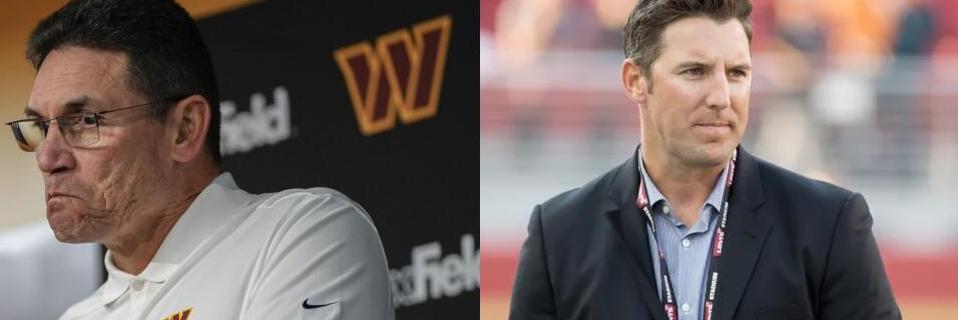
The Impossible Dual Role
NFL head coaches already live in the deep end. During the season, most average over 90 hours per week with a myriad of responsibilities: practices, meetings, film review, game plans, media, locker room management.
General managers live their own grind — roughly 70 hours in-season, ballooning to 90–100 during the offseason when free agency and draft prep take over.
So it’s no wonder that in the entire history of the NFL, only a handful of men have ever tried to wear both hats at once. The list is short for a reason: in today’s NFL, it’s nearly impossible to do both.
Coach-Centric Power Structure
When Dan Snyder hired Ron Rivera in 2020, he didn’t just make him head coach — he made him the final decision-maker on personnel, effectively the general manager. This was despite Rivera having zero front-office or roster-building experience.
The setup sounded collaborative in press conferences, but the reality was a coach-centric model that left roster construction in the hands of someone already stretched to the limit and unqualified for the role.
In a normal NFL organization, the general manager has final say on roster building. The coach reports to the GM, not the other way around. Washington flipped that structure on its head. Rivera sat at the top of the pyramid, with both Martin Mayhew (General Manager) and Marty Hurney (Executive VP of Football/Player Personnel) reporting directly to him. Publicly, they emphasized collaboration and shared philosophies. Privately, Rivera always had the last word.
Destroying the Offensive Line
Of all Rivera’s failures as a GM, the offensive line was the first thing he managed to screw up.
When he arrived in 2020, Rivera inherited one of the best left tackles of his generation in Trent Williams. Williams had clashed with Bruce Allen and the previous regime, but the relationship wasn’t unsalvageable. Rivera met with him and, instead of repairing the bridge, essentially burned it down.
According to reports, Williams wanted a better contract and some respect from the new regime. Rivera’s response? That Williams would have to “prove it” that season. To tell a future Hall of Famer — arguably the best left tackle of the era — that he needed to prove himself was not just tone-deaf, it was organizational malpractice. Williams was traded to San Francisco for pennies on the dollar and promptly reestablished himself as the league’s gold standard at the position.
Then came Morgan Moses, a steady, durable right tackle who had started every game for Washington since 2015. Rivera cut him in 2021, reportedly saying, “We can do better than Morgan Moses.” His replacement plan? A patchwork line filled with cast-offs from his old Carolina teams — none of whom came close to matching Moses’ production. Moses, meanwhile, kept starting for playoff teams elsewhere.
Within two years, what could have been a foundational strength — a bookend tackle duo of Williams and Moses — became one of Washington’s glaring weaknesses. Rivera didn’t just fail to build the offensive line. He actively dismantled it.
Pushing Out Kyle Smith
Rivera’s first offseason in Washington was also his most successful — and that was no coincidence. Much of the credit belonged to Kyle Smith, the team’s director of college scouting who had risen to vice president of player personnel. Smith ran the 2020 draft board, and the results showed: Washington acquired some late round gems in Antonio Gibson and Kam Curl while also making smart, low-cost additions in free agency like J.D. McKissic, Logan Thomas, Cornelius Lucas and Ronald Darby.
But instead of leaning on Smith’s eye for talent, Rivera chose to consolidate power. After the 2020 season, Smith was quietly pushed out of the organization. Multiple reports suggested Rivera wanted his own people and wasn’t comfortable sharing credit for roster construction.
It proved to be a fatal mistake. Once Smith was gone, Washington’s drafts grew thinner, the free-agent hits dried up, and Rivera’s personnel blind spots were fully exposed. What should have been the foundation of a rebuild under Smith became just another example of Rivera prioritizing control over results.

Reaching in the Draft & Tunnel Vision
Rivera also built his draft boards around holes on the depth chart instead of value on the board. Time and again, Washington reached to plug a need while higher-graded players slipped away.
Take the 2022 draft. With Matt Ioannidis and Tim Settle gone — and Daron Payne entering the final year of his rookie contract after Washington declined his fifth-year option — Rivera panicked. Instead of working out an early extension with Payne or trusting the board, he used a premium second-round pick on Alabama’s Phidarian Mathis. Most analysts had Mathis graded as a Day 3 prospect. Rivera took him at No. 47 as “insurance” in case Payne walked.
The result? Mathis tore his meniscus in his very first NFL game and missed the rest of his rookie season. In Year 2, he was basically invisible — barely on the field, never pushing for a starting role, and offering nothing but wasted snaps. By the time Adam Peters took over in 2024, Mathis was already a forgotten man. Peters cut him loose without hesitation, and the pick now stands as one of the clearest symbols of Rivera’s roster mismanagement.
Another of Rivera’s biggest flaws as a GM was tunnel vision. He came into drafts with “his guy” already circled, and once he locked on, there was no adapting to how the board broke.
The most glaring example came in 2023. Rivera openly admitted he was dead set on Emmanuel Forbes before the draft even began. When Christian Gonzalez — widely graded as a top-10 talent — slid right into Washington’s lap at pick No. 16, Rivera couldn’t pivot. He stuck to his plan, reached for Forbes, and left Gonzalez for Bill Belichick, who happily scooped him up one pick later.
What makes the Forbes pick even worse is what happened inside Washington’s own war room. Multiple reports described a screaming match when Rivera overruled voices in the front office who wanted Gonzalez. The room was divided, tempers boiled over, and Rivera forced through the pick anyway. It wasn’t just a bad evaluation — it was a decision made against the advice of his own football staff, showcasing exactly why coach-centric roster control is a recipe for disaster.
It was the classic coach/GM mistake: drafting for a preconceived plan instead of playing the board. Forbes struggled mightily as a rookie and was cut in the middle of the 2024 season, while Gonzalez was named to the APs- 2nd-Team-All-Pro squad. Rivera didn’t just mis-evaluate; he ignored his own staff, and the result was another wasted first-round pick.
Nothing captures Rivera’s draft failures better than the numbers: across his four draft classes from 2020 through 2023, Washington made 31 selections. Today, only five players remain on the current roster.
Enter Adam Peters
When Josh Harris convinced Adam Peters to take over football operations in 2024, Washington finally had something it hadn’t enjoyed in years: a true general manager running a true football operation.
At his very first press conference, Peters was asked what he thought of the roster. After a long pause, he answered carefully: “There are a few pieces.” It was a polite way of saying what most around the league already knew — Rivera had left the roster in shambles.
Peters’ mandate was clear: rebuild the foundation, restore discipline to roster construction, and modernize the way Washington built its team.
Building A Real Front Office
Where Rivera consolidated power and pushed out Kyle Smith — the very executive who helped build his best draft — Adam Peters did the opposite. He understood that no GM builds a contender alone.
One of his first moves was to hire Lance Newmark, fresh off helping the Detroit Lions rise from perennial rebuilders to NFC contenders. Just as important, Peters added Brandon Sosna to lead football administration, a move that highlighted Washington’s new commitment to an analytics-driven approach to roster building and cap management.
The contrast couldn’t be sharper: Rivera ran from collaboration, Peters embraced it.

Rebuilding The Offensive Line
Where Rivera dismantled the offensive line, Peters immediately made it a priority. In the 2025 offseason, he landed Laremy Tunsil in free agency, finally giving Washington the kind of elite bookend protector they had lacked since Williams’ departure. Then, in the draft, when Oregon left tackle Josh Conerly Jr. slid to No. 29 overall, Peters didn’t hesitate. He secured a potential long-term anchor in the trenches — something Rivera never managed to do.
Best Player Available
Where Rivera drafted for need and ignored value, Peters flipped the philosophy back to best player available. The clearest example came in 2025, when he used a second-round pick on Trey Amos, the Ole Miss corner who wasn’t Washington’s biggest need but graded as one of the best players still on the board.
It was a move that not only bolstered the secondary but showed Peters’ discipline in avoiding Rivera’s mistakes. Instead of forcing picks for short-term depth chart holes, Peters prioritized talent that would help Washington long-term.
From Chaos to Competence
Rivera’s incompetence as GM left Washington’s roster in shambles. Adam Peters’ strategic vision is already turning it into one of the league’s most balanced contenders — a team built on smart drafting, foundational investments in the trenches, and a modernized front office.
The lesson is simple: Rivera proved why coach-centric models fail. Peters is proving why real general managers matter.
Leave a Reply